Personal Protective Equipment (PPE) must be suited to the risk, fitted to the wearer, compatible with the task and not adding unreasonable discomfort or new risks. It is the last line of defence. CERN’s hierarchy of controls asks you to eliminate, assess, and design out a hazard before relying on what someone wears. Where a hazard remains, PPE closes the gap between the Safety Rules and the person doing the work.
Official reference: the minimum requirements for selecting, providing, using, and maintaining PPE at CERN, and who’s responsible for what, are set out in GSI-SH-5, General Safety Instruction – Personal Protective Equipment. This page summarises how that applies at CMS.
Who provides your PPE
| Your status | Who provides the PPE |
| CERN employed personnel, students and trainees (MPAt), temporary workers | CERN, through the Supervisor |
| Associated personnel (e.g. collaborators from institutes) | Their Home Institution, unless agreed otherwise |
| Contractor personnel | The contractor, unless agreed otherwise |
| Visitors | The unit organising the visit (CMS for CMS visits) |
Personal vs. shared equipment
PPE is in principle for personal use. Where the nature of the equipment and the work justify it, several people may use the same item one after another, provided that shared use creates no health or hygiene problem for any user. At CMS, this applies to the pool of fall-arrest equipment for working at height (harnesses and retractable lines), provided by CMS Technical Coordination.
Every item in the shared pool is individually identified and each issue is recorded. A competent authorized person inspects every item at least once every 12 months. Any item that is damaged, doubtful, or has arrested a fall is withdrawn from use immediately.
When you use shared equipment, you must:
- have completed the training required for the equipment, in particular for working at height;
- check the item for damage before and after each use;
- adjust it correctly to your own body each time you put it on and respect its maximum user weight;
- return it after use and report any damage, fall arrest or doubt about its condition when you hand it back.
If you work at height regularly, ask your Supervisor about personal equipment. The shared pool is intended mainly for occasional use.
Responsibilities
You, the wearer. Give your PPE a visual check before each use. Wear it correctly, for the task it’s meant for. If something looks worn, damaged, or out of date, don’t use it and report it instead.
CMS / your Subsystem Technical Coordinator. Make sure personnel working under their scope have the tools and PPE suited to the task, and that anything needing periodic inspection is actually in date. See I am a Subsystem Technical Coordinator.
CERN / CMS Technical Coordination. Provides PPE through the CERN Store or, for some shared equipment (see above), directly.
Maintenance and periodic control
Yearly maintenance campaign. CMS organises a yearly maintenance campaign covering all PPE procured through the CERN Store or managed via CMS or CMS MPE. Follow the official communications and bring your equipment (harnesses, retracting lines, height-work helmets) along to have it checked and re-certified in one go, rather than chasing an individual inspection separately. If you can’t make the campaign, CERN’s central inspection service can check individual items on request (Building 73). Be aware that the mentioned PPE needs a check at least once every 12 months regardless of which route you use, on top of the visual check you do yourself before and after every use.
What your PPE needs to comply with
Your PPE shall comply with CE marking and the relevant EN standard. Any PPE you use at CERN should be CE-marked and meet the EN standard that applies to that type of equipment (for example, standards covering safety footwear, head protection, or fall-arrest harnesses). Equipment bought through the CERN Store is procured to meet these standards already.
PPE needs by access zone: check ADaMS
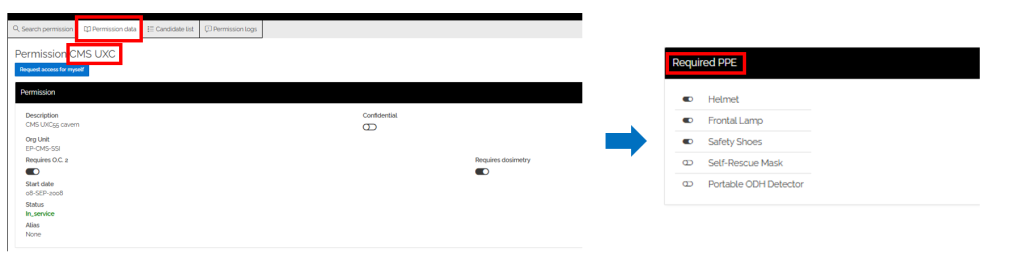
In case you do not know what PPE is needed in the zone you are planning to work, please contact your supervisor directly. For access permissions, the mandatory PPE is specified in ADaMS. Check Permissions > Search Permission > Enter permission e.g. CMS UXC > Required PPE. See also Access Requirements by Zone.
Portable Sensors (ODH & Gas Detection)
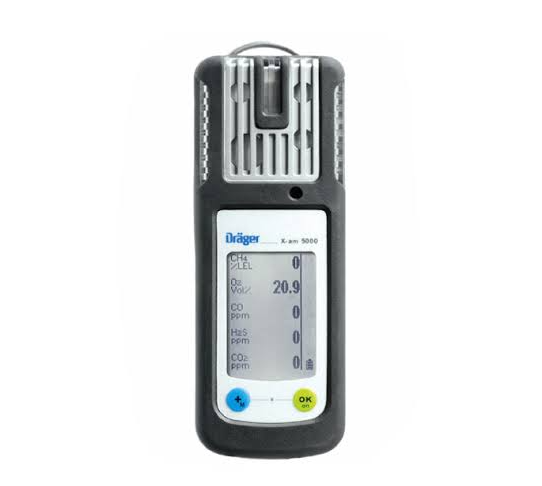
Portable gas detection sensors shall be used based on the zone to be accessed and the specific work activities being performed. Their use is mandatory in areas where Oxygen Deficiency Hazard (ODH) or hazardous gas accumulation (i.e. toxic or flammable) may occur.
All personnel must have successfully completed the online training for the correct use of Portable Gas Detectors prior to being authorized to use the devices. Each detector is configured with specific sensing cells depending on the atmospheric hazards expected in the underground areas. The following portable sensors will be available for LS3 operations at CMS:
- 3562/R-005 (CMS Control Room) – serving for general availability:
- 3x CO2, ODH, Flammable Gas
- 3x CO2, ODH
- 3594/R-006 (CMS Safety Office) – serving the CMS-Safety Office and as spare for malfunctioning- or sensors under maintenance:
- 2x CO2, ODH, Flammable Gas
- 2x CO2, ODH
- 3524/U2-001 (2PACL Room, USC55) – serving the 2PACL team for maintenance interventions:
- 3x CO2, ODH
Personal Dosimeter
Personal dosimeters are tracked separately from other PPE. If you lose yours, contact the Dosimetry Service and file their loss-declaration form as soon as possible. Your dosimeter is valid for 24 months, and you’ll get reminder e-mails before it expires. You will also find the expiration date of your personal dosimeter on the device itself. For further questions or to request a personal dosimeter, please refer to the Dosimetry Service directly.